In 2010, the RDS Forum started to debate expanding RDS. The new option was called RDS2 and is now fully specified in IEC 62106, all parts, 2018-2023.
With three additional RDS subcarriers, almost five times the data transmission capacity in comparison to conventional RDS was achieved. It can be used only with the ODA feature, including ODAs developed for legacy RDS such as TMC, using the tunnelling option.
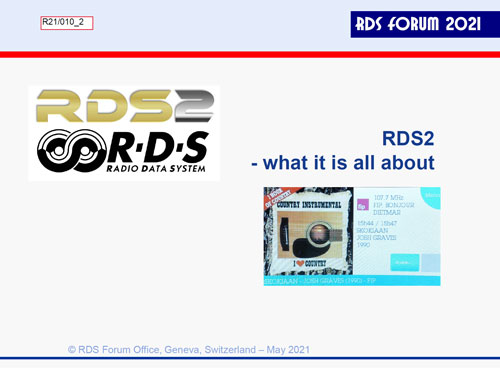
RDS2 is backwards compatible with existing FM/RDS receivers. However, to use the innovation, new receivers will need an RDS2 decoder for the additional data streams.
The technology mostly used now for FM radio and RDS decoding is called DSP, Digital Signal Processing, and it has led to very low-cost, mass-produced FM/RDS receiver chips for two decades already. With this same technology it is possible to easily decode four RDS subcarriers at once instead of only one, still maintaining the low cost of the IC, as established now, and on a similar market price level.
It is also assumed that not all future FM/RDS radios will really need RDS2. Only the receivers that will offer the new enhanced services will need RDS2.
In radios using microprocessors and SDR radios, RDS and RDS2 can also be decoded by software only.
RDS2 features
The new RDS2 features are Station Logo, Slideshow and Internet Connection.
RDS2 requires new RDS/RDS2 encoders that have fully implemented UECP as standardized in IEC 62106-10:2021.